February 29, 2008

Liliaceous chromolithograph

liliaceous (adj.): of the Liliaceae family that contains the lily, tulip and hyacinth

chromolithograph (n.): A color lithograph, specifically those of the nineteenth and early twentieth centuries

Another fairly random, short, post, with no specific focus. Anyway, a few things:


1. I'm surprised Josh hasn't commented about this, especially since he bothered to download the entire thing to his iPod. But they've ripped the sound track from Super Smash Bros. Braw, and you can easily find it on Youtube or elsewhere by googling "Brawl OST" (which is quite ironic, because as far as I can tell, it's not really official). Try this link. The song in that link is the "Final Destination" song for Brawl, and it's probably the best composition in the game. But of course, since it's more or less done by Uematsu.


2. Time for a real logic puzzle: Find a six-letter word such that any consecutive 4 letters or consecutive 5 letters are also a word.

So for example, if your six-letter word was "abcdef", then: "abcd", "bcde", "cdef", "abcde", "bcdef" would all also have to be words (in addition to "abcdef").

I randomly came up with this during a pretty long car ride, so perhaps it's not too hard, but I'm pretty surprised by how all of those turned out to be words. There's also very possibly more than one solution - the solution I'm thinking of though, also has the nice property that 2 (3 if you count slightly obscure words) of the 4 consecutive three-letter strings are also words.

If you can find a solution such that all the three-letter strings are also words, that would be very impressive. But that's probably impossible due to vowel-consonant positioning, etc.


3. I had the occasion to hear some music from Diablo II today (in a quite unexpected setting actually), which reminded me that it was a pretty amazing game. It's fairly cheap now, so if you're bored one day you should go and pick it up for $15-$20 or so.

The music was just a random note, by the way - the music is good, but it's not Final Fantasy epic good. It fits the game really well though.


Until next time, ciao.

-squidout

February 26, 2008

RGN#12: Kirby 64: The Crystal Shards.

To many this post's title may seem confusing, I post one thing saying that I'm reviewing games and suddenly we are at 12 random gaming notes (RGN)? Well yes, and no. The first ten RGNs were on my facebook page as notes and included other information other than reviews such as how to add channels to your wii and other semi-relevant information. The eleventh was my last post and that accounts for all eleven previous notes.

This video will pretty much sum up the game:
http://www.youtube.com/watch?v=1vdlEH0yFbg

When you have finished watching feel free to continue,


As you can see from the video it's a classic Kirby game with some character team ups and mixed powers. This however, is surprisingly a more difficult game than one might expect. This solely comes from the fact that there are a total of 100 crystals to collect and in order to find most of them you must take advantage of the multi ability use in this game. The only real downside to this game is that the game only has five worlds with five levels the fifth always being a boss level. This said every level must be revisited at least once to get everything. On a scale of 1 to awesome (10) this game ranks in at a good 7 or 8 . I urge any Kirby fans or gamers looking for a time waster to pick this game up. For $10 on the virtual console a good Kirby game from the N64 could be yours on the wii.

February 23, 2008

Cliquant heredes

clinquant (adj.): Glittering with gold or silver; a false and showy glitter

heredes (n.): Heirs

Funny words today. Clinquant comes from French, but it was actually first brought into English by William Shakespeare. You know, this isn't too surprising though - he actually 'invented' (i.e., took from other languages) thousands of common English words. Like "bump" for example. Next time you use the word 'bump' you can feel secure in your sophisticated-ness.

Heredes actually isn't an English word. It's a Latin word. Unsurprisingly, it means 'heirs' in Latin. But just like other Latin words, it sometimes crops up in the context of law, where the word 'heirs' isn't anywhere near good enough, of course =).

Anyway, I'm not really sure what to post. I could talk about why the moon was red, but I don't feel like it and you probably all already know it's because of scattering in Earth's atmosphere. So instead, I'll keep this post short, and present a nice little paradox my friend showed me:

You've probably played a lot of two-player games, like Tic-Tac-Toe, Chess (it has rules to make sure it is finite), two player Ghost, Halo, etc. Most such two-player games are finite - meaning that you finish after a finite number of "turns" or a finite amount of time.

However, one can easily invent infinite two-player games. For example, if we randomly make a game Asdfmas where turns consist of saying numbers and if someone says a negative number, they lose, is very easily infinite.

Now, one would assume that a given game is either finite or infinite - after all, if a game doesn't take an infinitely long time, then it has to be finite, no?

Well, then, consider the two-player game called Metagame. The rules of Metagame are simple. Player 1 chooses a finite two-player game, and Player 2 moves first. The question is, is Metagame finite or infinite? (If you immediately think it has to be finite, think again for a bit. Then scroll down.)


Obviously, the Metagame has to be finite, right? After all, they just play a finite game, which can't take infinitely long? Well, since it's finite, Player 1 can choose the Metagame. Oh, then Player 2 can choose a game too. Why doesn't she choose the Metagame as well? Player 1 also feels like playing the Metagame again. Hmmm...

So, the Metagame is infinite? But how can that be? After all, they just play a finite game. Hmmm....

Hopefully that's fried your brains for now. Until next time, ciao.

-squidout

PS: Here's another paradox for you, this time with a touch of Godel:

What is the smallest positive integer that cannot be defined with less than 81 characters?

(Hmm, "the smallest positive integer that cannot be defined with less than 81 characters" happens to have 81 characters...)

February 20, 2008

Lunar Eclipse

As everyone has probably heard, there will be a total lunar eclipse tonight, Feb 20 (and Feb 21 morning for Europe and Africa) for the Americas.

A total lunar eclipse happens when the moon passes completely behind the Earth's shadow:


When the moon is in the umbral shadow, it looks red:

Cool!
I happen to have a perfect view of the lunar eclipse from my bedroom, and now the moon is already in the prenumberal shadow and moving into total eclipse. In Toronto, it is expected to be in total eclipse around 10PM. I'm definitely going to be getting up from the desk every so often to watch the moon :)

Cindy

Encaustic pinxit

Encaustic – A painting medium in which pigment is suspended in a binder of hot wax.

Pinxit - Lettering on a print that denotes the original artist of the work for, or from, which the print was made (from Latin Pinx, meaning "he painted it")

Two art words! That's a change. Anyway, to start off, I found this the other day, and while it is kind of old news, so I wouldn't be surprised if some have seen it already, it's kind of funny. Well, maybe not funny, but it reminds me of all the times that someone has asked me "if you could have one wish, what would it be?" to which I, or one of my friends, would generally reply unlimited wishes. While the concept is funny, though, in actual fact, it's kind of sad how someone would destroy the Make a Wish Foundation like that. Wishing away the foundation's legal team was pretty smart, though…

Today, 49 years ago, Prime Minister John Diefenbaker of the Progressive Conservative Party cancelled the Avro Arrow program. That was a sad day for Canada. The Avro Arrow could have become the fastest plane in the world. It could have become a great defense for Canada, especially with the constant threat of Soviet bombers at the time. It could have given Canada something to really brag about. But, no. Instead, it became a $400-million pile of scrap metal. It may not look like much (especially since this is the Arrow without many of the features that were intended to be included in it), but you can watch its maiden flight here. I think it looks pretty cool. I'm really not an expert on the subject, so go to Wikipedia if you want to learn more about it.

Warning: do not click on the following link, unless you have a fair amount of time on your hands. It is far too addicting. Which is probably why it's on addictinggames.com. Anyway, you have been warned.

Filler is a very good game. Basically, the goal is to fill at least two thirds of the game screen with circles, while avoiding the evil bouncy balls. When each level starts, the bouncy balls start bouncing around, and then you have to place your circles so that, while they are growing, they do not touch a bouncy ball. When you hold down your mouse, a circle starts growing around where you clicked, and it stops when you either let go of the mouse, the circle you are making touches another circle you already made, or the circle touches a bouncy ball. In the latter case, you also lose a life. Each level, you only get a certain amount of circles and lives to place, though. If you run out of lives, you lose, obviously, and if you run out of circles, you can continue to place more, but each takes a life from you.

You now know enough to skip the game's introduction and play on your own! You should get used to it fairly quickly, so don't worry if you don't understand everything. The last couple days, I played this game a lot, and, as I am so nice, I'll give you a few pointers to make it, at least, to level 50 (though, my best so far is 76).

  1. Don't bother rushing. You have lots of time each level, and plus, if you run out of time, it doesn't matter. You just lose a few bonus points. Try to spend more time optimizing the size of the balls. That being said, though,
  2. You generally have many more balls than you need for each level. Don't wait too long to make your move, as you could probably easily pass the level with 5 or 6 huge mistakes, even more past level 15.
  3. Use gravity to your advantage. As far as I can tell, all circles seem to weigh exactly the same, no matter their size, so, for instance, if you have one really big circle on screen, you can push it over with a few small circles, and clear up some space to place two or three decently-sized circles, in most cases.
  4. Try placing circles in the top left corner. Placing them in a top corner is good, because then when they fall, they move bouncy balls that are below out of the way, clearing space for you to make another circle. However, the top right corner is bad, because when a bouncy ball gets trapped by your circles against a wall, then is squished, it teleports to the top right corner, which can be annoying when you are in the middle of making a big circle there.
  5. Lastly, try catching the bouncy balls in small spaces, so that they aren't bothering you wherever you are placing circles as much. Usually, you do this by accident anyway, and it is somewhat hard to do when you are trying to, but if the opportunity arises, go for it.

I'm wondering if there is any space at all once you get to, say, level 100, so if anyone manages to get there, let me know. Anyway, that is all for now, so à la prochaine!

February 19, 2008

Sexpartite lunette

sexpartite (adj.): Composed of or divided into six parts, as in a sexpartite rib vault.

lunette (n.): Something that has the shape of a crescent or half-moon (especially when referring to an architectural feature)

Latin and French today. Although, 'lunettes' in French does mean glasses, but 'lune' is moon. Actually, glasses (especially in old times) were often crescent-shaped (i.e. "half-moon glasses"), so this isn't too surprising. Anyway, finally some words that aren't biology.

Last post I might have said this post was going to be about lasers, but as usual, that was a complete fabrication. I'll talk about puzzles instead. Japanese puzzles mainly. Especially the puzzle types published by Nikoli, and particularly Nurikabe, which I've recently ordered 5 books of from Japan - they're written in Japanese, but luckily you don't need the words, and the numerals are most likely Arabic, but even if they aren't, learning ten or so Japanese characters won't kill me.

But anyway, what is Nurikabe? Well, it's a Japanese word for "invisible wall randomly in the middle of a road." More relevantly, it's a puzzle type invented by Japanese puzzle company Nikoli, who also brought you Sudoku. A short explanation is basically: you're given a grid with some numbers on it, and you want to fill some squares in black so that the numbers are on white islands with 'number' many white squares. But this flash tutorial will probably be much better at explaining it to you: http://www.nikoli.co.jp/en/puzzles/nurikabe/. Good quantities of printable puzzles don't seem to be readily available on the web but there are a bunch of online sites that publish a new one every day or so and that you can solve in your browser - just google nurikabe.

I think it's pretty similar to Sudoku in terms of average difficulty. Perhaps it's a bit harder at first, but you get used to it very fast anyway (and sudoku is probably annoying at first too... although I don't even remember when I first saw sudoku). A puzzle that I really find annoying to do are "Paint by Numbers". They're pretty popular - you may have done one or two of them. Unfortunately I never got the hang of them and they take me really long.

Interestingly, Paint by Numbers, Nurikabe, and Sudoku (it's extension to n^2 by n^2 grids) are all NP-complete, which at least means you can take solace in the fact that your computer won't laugh at you any time soon (that said, it could still solve them faster than you could).

Anyway, the Nikoli site has a bunch of other interesting puzzles. Shikaku looks interesting but they only invented it recently so there are practically no available puzzles. There's also puzzles with very funny titles, like "Where is Black Cells".

I think that's all I'll write about puzzles today. Maybe I'll conclude with some random remarks.

I rewatched Goldeneye the other day, and have come to the conclusion that it was the best recent James Bond movie. Perhaps James Bond out of the cold-war era is getting a bit strange now, so people are altering the genre a bit (*cough* Casino Royale *cough*). But whatever.

My friend told me to go get some random "Solar something" RTS game but when I went to the IGN site to look it up I got distracted by: http://xbox360.ign.com/articles/852/852953p1.html. It's about time for a new Banjo Kazooie.

This person has a lot of good trance/techno mixes and songs posted. If you like the genre (unlike some people...) you should check it out.

And that's all for now. I could talk about lasers next time, but I'd probably just copy what Munroe said and add something about petawatt lasers... so just go read his blog post! Ciao.

-squidout


By the way, the post is in the above picture. Quality 7.

February 18, 2008

Crocodilian scleroderma 2

So, this is basically a follow up to yesterday's post.

And the program I told you about is now on the sidebar. Of course, you'll probably need Python to run it, but that's fine. stegano.py will hide a file of your choice in a bitmap and unstegano.py will bring it back. Pretty handy.

Now, you'll notice that you can specify the quality of your steganization. This basically describes how many bits of the hidden file we hide per byte. So it ranges from 1 to 8, with 1 being very subtle (you're only altering the LSB) to 8 which is very unsubtle (the entire pixel is replaced with stuff from the hidden data). The bonus is, of course, 8 takes up 1/8 the space of 1. Even 2 takes up only half the space of 1, and looks the same to my eye. To see the difference between the qualities, here's the first two paragraphs of this post repeated 5 times hidden in Mr. Happy from yesterday at all possible quality levels:

Quality 8:

Quality 7:

Quality 6:

Quality 5:

Quality 4:

Quality 3:

Quality 2:

Quality 1:

Original (no hidden info):

It should be noted that it always takes the most significant bits from the image, so even with quality 7 (where there's only one bit from Mr. Happy) the noise is quite "see-through".

Now, how can the evil enemies detect this? Well, there are lots of advanced statistical image processing techniques they can use to see if there is something "beneath" the image. You can go google 'steganalysis' to figure out how it's actually done - I'll just show one of the most crude techniques.

First, behold the below image of some random very badly built Mechano toy that I threw into the snow today:

You'll notice it's a JPEG. That's because I'm definitely not going to upload a 1632 by 1224 bitmap image for you. Definitely not. But I did the following test with a bitmap, so no worries.

The reason, of course, that I'm not going to upload a 1632 by 1224 bitmap for you, is because bitmaps are big. While the bitmap is about 5 megabytes large, the corresponding JPEG is only 122 kb. So, a lot of space is wasted in bitmaps. And we make use of that space when we hide stuff in them.

Of course, every 1632 by 1224 bitmap file is about the same size. But, what if we try compressing them? I have a feeling a 1632 by 1224 black rectangle compresses just a bit better than the above image. Similarly, if we hide information inside bitmaps, it has to be compressed too. So hmm...

In any case, I took the Gettysburg Address (1.4 KB), the Declaration of Independence (9.1 KB), and Dickens' Great Expectations (997 KB), and hid them all (with quality 2) inside a copy of the above image. Then I zipped the resulting images. The results:

Hidden InformationSize of Hidden InfoSize of Compressed Result
None (original picture)0 KB1646 KB
Gettysburg Address1.4 KB1648 KB
Declaration of Independence9.1 KB1652 KB
Dickens' Great Expectations997 KB2168 KB

So, you can notice a difference =).

Of course, this is a very hard test to do if you don't have an original picture, because different images compress differently. But you can generally notice if someone is trying to hide Great Expectations =).

Oh, and perhaps I didn't mention it, but of course, you can hide any type of file this way (because after all, all files are ultimately binary). Hiding Mr. Happy in:

(I know, we'd usually hide the Secret Plan in Mr. Happy, but the Secret Plan file is bigger, so stick with this), at quality 4 we'd get:

Yeah, it's noticeable but whatever. Given all the other random things happening in that picture, it doesn't look so off. If you use quality 1, 2, or 3 though usually you don't notice anything.

In any case, this was my first 'big' project in Python, which seems to be a really powerful language even though I only know about a quarter of its features. It may not be as powerful as C++, but it's probably a good choice for someone new to programming to learn.

Anyway, there are a bunch of improvements that you could probably make to the programs. The first is modularizing it and allowing to bypass the annoying input so you can do tests like the one above much more easily. Secondly, non-integer qualities would be nice too. Like, if I have lots of room, I should be able to set it to say 0.3. Since quality acts harmonically (1/n ish), there'd even be a considerable difference between 7.3 and 8. The nicest thing would be to figure out the best possible quality that takes advantage of the entire file - because only using the bottom n rows is pretty dumb. destegano should be able to figure out how large the file is by itself (although honestly, any self-respecting file type allows extra zero bytes at the end, so we could just choose the size of the steganograph). Also, it needs to be optimized a lot - hiding Great Expectations took quite a while. But for a quick hack, it's pretty nice.

If you actually bother getting it to work, have fun playing around with it and hiding files from other people. But that's all for now. Maybe next time I'll talk about laser beams or something.

Until then, ciao.

-squid out

February 17, 2008

Crocodilian scleroderma

crocodilian (adj.): belonging to the order of large reptiles, Crocodilia

scleroderma (n.): a chronic disease characterized by excessive deposits of collagen in the skin or other organs,

By the way, crocodiles are the closest living relatives to birds, since they both happened to evolve from dinosaurs.

Anyway, I felt like posting, so since I've been programming a bit of stegano stuff in Python recently, I think I'll move on from swords to steganography.

Steganography ('stegano' for short), for those who have no cryptography experience whatsoever, is probably best explained like this: Let's say you want to send a secret message to your friend, containing say, the word "crocodilian". This is known as the plaintext - it's the net information that you want to send to him. But the evil enemies want to know what you're sending to your friend too, and with their unlimited resources they can intercept the messager or mailman or telephone or e-mail or any other means of communication you can think of. So, naturally you encrypt it and turn it into ciphered text (often shortened to just ciphertext) by say, shifting every letter one letter forward: "dspdpejmjbo". Of course, your friend needs to know that everything is shifted one letter forward too, but presumably you arrange this ahead of time. Anyway, you now send this to your friend and it gets intercepted by the evil enemies. Now, the evil enemies notice something fishy - why would you bother sending your friend a string of gibberish letters like "dspdpejmjbo"? So, suspecting something, with their multi-million dollar budget they hire a crack team of researchers who manage to crack your code in a few years - and your secret has fallen!

Of course, one way to avoid this is to simply make the cipher trickier (two spaces forward!). But another way (and the way related to steganography), is to just not make them suspicious. We could do this, say, by making an English sentence where the first letter of every word corresponds to the letters in "dspdpejmjbo" - such as: "Do stupid peons derail planes entering jam made joyously by Olga?" When the evil enemies intercept this, they would, of course, find nothing unusual about the sentence and just let it pass through. After all, they can't spend a multi-million dollar budget analyzing every message that comes their way for hidden information.

So, in short, ciphering is hiding information; steganography is hiding the fact that you're hiding information.

Steganography is a pretty cool part of cryptography in that there are so many possible ways to do it. You might have noticed, that the sentence I constructed above is pretty fishy (i.e. they might eventually notice something was a bit peculiar about it). Also, even for a short sentence such as this one, you'd need almost an entire paragraph (if not more) to hide it all in that manner. So nowadays, most stegano stuff is done by hiding the information digitally in the insignificant layers of files.

Take the above black box, for example. If you copy it into Paint (or an equivalent) and play around with it for a while, you'll notice that it does contain the information "dspdpejmjbo". This is quite more subtle than "Do stupid peons derail planes entering jam made joyously by Olga?", since now you can hide a hidden message inside any block of uniform color. You can even hide the block too - you could include it surreptitiously at the bottom of a photograph or something.

But the evil enemies are getting smarter, and have just written a computer program that checks all picture files for blocks of uniform color, and then tries floodfilling the block with various colors to check for hidden text. So how do we get around them now? There's a very nice way to do this, but it is slightly more technical.

Of foremost importance is understanding how .bmp (or any other graphics extension of your choice, although they tend to be much more complex) files are stored. Luckily, with a hex editor it's not very hard to find out (if you don't know what a hex editor is, go learn to use a computer).

Open some arbitrary bitmap file (the one below, for example) in a hex editor.

If you do open it, you'll see lots and lots of bytes represented in hexadecimal. Of course, hexadecimal is always used because 16^2 is 2^8, so one byte goes to two hexadecimal characters. Similarly, ASCII ranges from 0-255 for the same reason; you can express one ASCII character with two hexadecimal characters or in one byte.

Now, if you're not used to hex cracking stuff, it'll probably look a little foreign. But if you play around, you should be able to figure out what most of the things are. For example, the first 2 bytes in a .bmp file are always "42 4D" - representing the ASCII "BM". This basically helps programs identify it is a bitmap (a nice trick is, if you are ever given a mystery file, open it in a hex editor and look at the first two bytes - they often identify the format of the file).

Then, bytes 3-6 denote the file size of the bitmap, in bytes (yes, there are only 4 bytes for this - we too hope that you don't feel like making a 4.3 GB bitmap file anytime in the near future). Now, if you look at the file size of something, you'll note that it's represented a bit oddly. By that I mean, they put the least significant bytes first.

What does that mean? It's basically akin to writing the number 7543 as 3457 - here the least significant digit, 3, appears first. Although, you don't need to worry about the bytes, so if you see "5E", that really means 5*16+14 = 94, not 14*16+5 = 229. Altogether, that means that something like "5E 26 00 00" actually represents the number 26*(16) + 5E = 9822 - not 24102, and definitely not 1579548672 (by the way, forgive the flipping between hexadecimal and decimal so often - only 26 and 5E are in hex there).

There's a lot more information encoded like this, like the length of the picture, the width of the picture, etc. However, we want to get to the interesting stuff - the actual picture. So skip ahead to byte A. This tells you the byte at which the actual image information starts. For my computer it's usually 36 - so the 54th byte. But it could change depending on the operating system, settings, the actual image, etc.

Now, you'll see familiar triplets of bytes - they encode the RGB values. So, if the 54th through 56th bytes are "00 FF 00" that means that the RGB of that pixel is "Red: 0, Green: 255, Blue: 0", so it's a green bit. (Actually, it's really the BGR values - the first "00" is the blue value - but we don't need to worry about this since we treat everything the same).

The observant person might have noticed that when I said "that pixel", I never really specified what pixel I was talking about. Now, you might intelligently assume that the first pixel would be the pixel in the top-left corner - but you'd be wrong. After all, if you look at the image, the pixel in the top left corner is cyan, not green. So hmm...

For some reason (hey, don't ask me) bitmaps represent the picture data from the bottom up - so the first pixel is actually the bottom-left corner. Then the next pixels are all along the bottom-most row, then they proceed to the second bottom-most row, etc. all the way to the top row.

Of course, that's not nearly annoying enough. To make things even better, they force the width to be a multiple of 4 - so you'll find that if you have 6 pixels in a row, you'll see the RGB's for those 6 pixels, followed by 2 "00 00 00"s.

Luckily, none of this matters to us, since we just want to hide "dspdpejmjbo" in the data. The first step is to translate that to an equivalent hex string: "6473706470656A6D6A626F00". Now, we're going to break up that hex string into triplets of characters: "647 370 647 065 6A6 D6A 626 F00"

Now what do we do? Well, consider the R hex value for some random pixel, say "A2". Now, this represents a red value of 162. Now, if we changed it to say, "A6", you probably couldn't tell the difference. But if we changed it to something like "62", you probably could - the red value has changed by 64.

We call the "2" the least significant bit (although it's really 4 bits, but shh). We basically are just going to replace the last 4 bits with one bit from our message. So for example, if our first pixel was "A2 B3 C4" it would get changed to "A6 B4 C7", since our first triplet is "647".

And when we do that, the new picture is:

Now, our message wasn't very large, so all of it managed to hide in the bottom row. You can notice the steganography in paint, since we are doing +/- 16 shifts to the color values. But nevertheless, it's a pretty nice way of hiding information. And I bet the evil enemies wouldn't suspect anything!

I'm going to go play Halo 3 with somebody now, so I'll stop now, but I'll post more about this later - like my program that automates the process, how you can actually detect stegano, and how to hide pictures within pictures.

Until then, ciao.

-squidout

Returning, finally.

Sorry to keep the dry spot with no posts from me lasting so long. I am back with more to talk about and I will try to post as often as possible now.

Just seeing the creature on the right (I hope) many will immidiatly understand my absence.
For those who don't this is a screen shot from super metroid the third installment in this nintendo produced series and my personal favourite. To give a brief explanation as to this game and whatever relevance it has to SG, here we go.
Super Metroid: after the first metroid on the NES, the space pirate leader Mother Brain is destroyed. In Metroid 2 on Game Boy Samus destroys all the metroids except a hatchling which thinks Samus is its mother. Super Metroid takes place soon after that when Samus delivers the final metroid to researchers. after leaving the research station ceres she recieves a distress call saying the station has been attacked. The game begins with samus, with none of her suit's abilities from previous games (for some inexplicable reason) attempting to save the metroid and eventually returns to the planet where it all began Zebes to save the metroid.
I have recently beaten this game on the Wii's Virtual Console and haven't done much else with my time.
The relevance to SG?: Since Point-Counterpoint wasn't so big I figured I'd do what I do on facebook where I give gaming news and review games for others to play. This said I recomend everyone with a wii goes and gets this game for 800 points.
Till next time,
Aaron

February 14, 2008

Re: the last 3 posts

So, right off the top, I want to say that even if the Olympics were in Beijing (which they are going to be), and I significantly disliked Beijing, I would probably not hate them, and still watch events that I found interesting. I guess maybe if you are like the US in the Cold War when the Olympics were in Russia, you might have an okay reason to dislike the Olympics, or not send anyone to them, or something similar, but I highly doubt that China is planning on launching nuclear bombs at Amir, and we know that in general he does like the Olympics (see the second sentence of his post), therefore I do not see why Amir should hate the coming Olympics. Plus, the whole point of the Olympics is to spread unity and peace, not spark debates comparing the US to China. But, as the debate has already been sparked, I will join in. Now, I probably don't know much about the situation in China at the moment, and I probably have a huge bias towards the US, as I, and most of my family that I know, were born there, but I'll try to not be too bias. Well, the next paragraph might make this seem unlikely, but just hold on.

First of all (to demonstrate my bias, it would seem) I think the founding fathers of the US were very smart people. The US declared independence on the 4th of July, 1776, because it got mad at Britain for implementing all sorts of taxes on them without their consent. In fact, they didn't even have representatives in British parliament. Nobody likes being taxed, especially when you don't even get to choose who is making you pay more taxes, and thus, people got mad. "No taxation without representation," coined by Jonathan Mayhew, became a prevalent view among people in the US. So, they fought the British for their independence. Right at the beginning of the war, however, the founding fathers drafted the Declaration of Independence, which stated very clearly:

"all men are created equal."

Basically, the US was made because its citizens wanted to be fairly represented, and choose what happened to them. Therefore, many years later, when Communism came around, it would make sense that they disliked it, as it was more or less what they had fought against for independence. Thus, everyone started hating communists, and, among other things, ignored fascists, which may have helped cause the Second World War, but that's another story. While it may be the case that democracy was good for the US, however, this is not the case for all countries. If what Cindy said is true (which I assume it is), then China needs communism to be able to do anything. Obviously, this is not the case for the US, for instance, as they manage to do things like declare war on Iraq, but once again, that's another story. But then, Amir says: "I also don't like how the Chinese government is letting hundreds of thousands of little girls and women be raped by Arab militants." I don't know whether this is true or not, and assume that there is at least a little bit of fib in it. It makes sense, however, that people in the US would blame the Chinese government for this, though. Basically, they see a country where the population has no say in what happens, and people being raped (or at least they are being told that they are seeing this by people like Amir), and probably think that the situation in China is similar to theirs back in the 1770s, and thus blame the Chinese government. Once again, I don't know enough to say for sure (maybe I'll look into it when I don't have stuff to do), but I think that the situation regarding Falun Gong looks a lot like Britain taxing the US without asking them first, too, and if the people of China started revolting against the government, I would be surprised if the US didn't help. However, I haven't heard of any revolutions in China recently, thus I assume that the people of China don't care as much about being persecuted for practicing Falun Gong as Americans did about being taxed, or that they value productivity more than they care. At any rate, both sides have pretty valid points. I guess it all depends on your perspective…

Now, in Jon's post, he discussed how hive-mindedness probably comes naturally when there are many people. To an extent, I agree. I guess I don't really know both sides to this one, but in the stereotypic view of most Western people, Chinese are mostly as Amir described in his post; they accumulate money, status, and achievement for the sake of achieving money, status and achievement. Stereotyping is very bad. I am sure that that is not the case with all Chinese people. I would be highly surprised if everyone just did lots and lots of work to get good grades. I know many people in the US and Canada don't. Then again, it may be in Chinese culture to make your children do lots and lots of extra work so that they succeed, which might cause lots of people to "strive" to do well, or copy their neighbors in playing music, which I have heard alot. Whether or not either of those are true, they do remind me a lot of the American Dream, as well. Though, there is one big difference that I see. The American Dream is that all Americans have the opportunity to do whatever they want to through hard work, because the US is a free country. While this opportunity is available, not many Americans actually seem to work very hard, which is true of most people, because they don't see the point in working hard when they could just not work hard (nor do I, in most cases). While Jon's point on the matter does have validity, I think that, if the Chinese did not make their children strive to do well, there would be a wider range of people's views on working hard in China, as there is in the US. Then, when he says that the American Dream is what is on the mind of all Americans, I disagree, because, firstly, nowadays, the American Dream is usually only associated with immigrants coming to the US so that they can do better than they were in their home country, but also, not close to the majority of Americans actually take advantage of the opportunity they have to work hard then succeed. Walking around any part of the US that is not a rich neighborhood will show you that (ie, Broadway probably doesn't count). Plus, the only time I remember hearing about or thinking about the American dream, with the exception of now, in the last 4 or 5 years at least, was when Harry Potter married his best friend's sister. I doubt that most Americans have just that on their minds. Anyway, that is all I have to say for now, and I have to go eat, so I will leave my comments at that. Maybe I'll write more if I can think of more to say. Or if Amir or Jon or Cindy writes anything else that I feel like commenting on. En tous cas, la prochaine!

February 13, 2008

Re: Amir's Rant

I had so much to say about Amir’s post, that I stopped writing a comment, and decided to do a post instead. Politics happens to be one of several subjects that are extremely touchy, like religion, so I hope I don’t offend anyone, first of all. Anyway, I think I have a pretty weird/unique standpoint, because although I was born in China and I do talk with my parents about Chinese culture and politics, I also left China at a very early age, and my environment has made me quite Western in terms of philosophy and way of life. So, I have these two viewpoints that both influence me.


The main thing I want to say is that I think Amir’s post (and most of the Western world) antagonizes China too much, and that they are not unbiased like they may think. (Just wanted to make it clear that I’m not saying that I agree with what the Chinese government is doing, especially in terms of the human rights violations.) Ok, here goes:


On Communism and Propaganda:


After I read Amir’s post, I immediately told my dad about it, and had a discussion with him. What he said boils down to: China needs communism. In a big country like China, both in terms of land mass and population, competing political parties would get nothing done. And that is unacceptable. Thus, China needs one strong leader with one strong party, and communism just happens to be that. And propaganda – it’s necessary for the government to function, so it remains. It’s about power and stability.
To outsiders looking in, this way of living, this lack of democracy, is horrible. But to people living in China (though there is a distinction between city and country folk), it’s not all bad. They like having a leader who knows what to do, and follows through with it – someone who is in control of things. I do think they would rather have this stability than a democracy that gets nothing done.


On Darfur:


It’s horrible, the civil war in Darfur. Nothing with people dying unnecessarily is good. Again, not trying to defend China’s actions, but then again, if the U.S. can benefit from invading the Middle East with oil, why not China from Darfur? Ok, not necessarily a good thing, but at least China is buying the oil, not seizing it. Again, China’s not the only one doing the bad things. If the U.S. is so good (which is the vibe I seem to be getting from Amir’s post), how can you be such a hypocrite, ignoring the things the U.S. has done and is doing, and attack China’s actions?


On Falun Gong and Tibet:


I do believe Falun Gong the practice itself is beneficial to the body (like Tai Chi, for example), and has helped people, and I don’t agree with the torture that the Chinese government uses on people who practice Falun Gong, but I think the West simplifies the issue too much. The West focuses on the ill-treatment of these people - what human rights violations China has committed - while it has not examined the other side of the issue, namely why the Chinese government hates Falun Gong so much. Because the conflict is definitely not unprovoked; the conflict is in fact very much political.
The Chinese government, in the beginning, supported and gave grants to Li Hongzhi (creator of the practice). Then, in 1999 – after seven years of the practice being taught and spread – the Chinese government banned it. You have to ask yourself why the Chinese government would suddenly start banning it without provocation, after promoting it for seven years. The Chinese government said that it banned the practice because “Falun Gong was a highly organised political group ‘opposed to the Communist Party of China and the central government, preaches idealism, theism and feudal superstition’. It attempted to make the distinction between ‘ordinary core members’ and the leaders, which it referred to as ‘a small number of behind-the-scenes plotters and organizers who harbor political intentions’.” (http://en.wikipedia.org/wiki/Falun_gong ) Li Hongzhi, of course, replied that Falun Gong was not a political organization, and that it had no wish to overthrow the Communist government. After that, nationwide persecution began. It’s all politics. China didn’t start persecuting for no reason; it started it because it believed there was a conspiracy to overthrow the government. Not sure if this conspiracy is real or not, but just trying to say that all this persecution and torture started for a reason - the fear of rebellion – and to the Chinese government that is reason enough. So, Amir said, “In fact, you mention the Falun Gong, and you are pressured, prisonned, and in the case of international lobbying, bullied into ignorance and compliance.” I say: of course, to the Chinese government, this is what it takes to stop a rebellion against it.


Same thing with Tibet – it’s all politics. I know lot of people hate China because of China’s treatment of Tibet, but China is just trying to do what all countries want – to keep its territory. So of course China won’t let Tibet be independent; it is a self-governing province though, like Shanghai is a self-governing municipality. And of course China doesn’t want other countries to interfere with its internal affairs.


Same with Taiwan, too; it’s all politics. China wants to keep the land, and doesn’t want other countries poking their noses into what China thinks is its own business, and therefore no one else’s business. All of this stuff, it’s nasty politics.


On the U.S. vs. China thing:


Amir said, “But its an indication of the mentality of the nation. Its closed mindedness, similar to Soviet Russia, will be its downfall. For it is the economic philosophy of the U.S. that will keep it strong for years to come. It is its transparencies that allow dark regiems to rise, but it is also this transparency that allows the system to correct itself.”
By economic philosophy, what do you mean? Capitalism? The thing is, the U.S. isn’t doing that well right now. I mean, I do think things might change with a Democrat president, if that is the outcome, but the U.S. economy is doing so much worse than China, and the country remains billions of dollars in debt, if not more. So I ask, what is it that is keeping the U.S. strong, as you say? Right now, what I’m seeing is China getting more and more power, and then there’s the U.S. both trying to stop China from getting power, and trying to get on China’s good side so it can benefit from China’s wealth at the same time. (Don’t know how well that works.) China, on the other hand, seems to be doing quite well. Of course, no country can do well forever, like the U.S. has shown us, but this is the situation right now – China is getting more power, and the U.S. seems to be losing its grip on the position of number one.

---


Ultimately, life is not fair. Politics, especially, is dirty. Everyone wants power and money; some people say that there is inherent good in human nature, but there is inherent greed and selfishness too.


I guess I do agree with Amir on the one thing, about superpowers – yes, that is what they do. They abuse their power. But just trying to say, China is not the first country to do this. And it will not be the last.

Cramoisy ascites

cramoisy (adj.): a crimson red color

ascites (n.): an accumulation of fluid in the peritoneal cavity.

Okay, I started writing a comment on Amir's "Rant of Political Nature" (see the post below this), but then it got pretty long, so I decided to put it into its own post. So, voila (you should probably read his post first, if you haven't already):

---------------------------------------------------------------------------

You really need to be careful not to get too biased. Otherwise your points become really unconvincing.

1. "I also don't like how the Chinese government is letting hundreds of thousands of little girls and women be raped by Arab militants"

This is probably true to some extent, but you are looking at it so one-sidedly. You know, the UN doesn't even allow the War in Darfur to be called a genocide. That's because it's a lot more multidimensional than just a genocide - i.e. "genocidal intent appears to be missing", in their own words.

By no means do I claim to be very knowledgeable about the War in Darfur (or call it genocide if you will, the semantics are irrelevant to what's actually happening), but it's fairly obvious that the war isn't just about social or ethnic issues. In fact, no war is just about social or ethnic issues. The economy always gets involved, somehow. And it's not hard to see why in Darfur - the place is a desert!

Now, if you think about this, a UN reaction could possibly stall the fighting for some time, but has the UN ever really succeeded in repairing an economy. The UN has just too many divided interests to do such a thing successfully. I'm fairly sure they've worsened some economies, but I don't think there's really a case where they've helped a developing nation become self-sufficient.

Yet, ironically enough, if China moves in for oil and other natural resources, this inevitably creates local jobs. And while we can't put good faith in any predictions we make, once a stable part of an economy is set up, the rest of the economy tends to flow together nicely. You can see this in many cities - originally they may have been for some specialized purpose, say gold mining, but then developed into economic centers. So, China might be able to help the conflict in Darfur more than the UN, ironically enough.

2. Chinese censorship

Err, yeah. This is one of the unpleasant remaining vestiges of communist China. I do say remaining though, because China has gotten a lot better recently - it's practically emerging from a revolution, after all.

Whenever a country progresses into industrialization, things get shaken up a bit. It's only natural that it happens - you can't really flip the economy around without causing something to happen. In the so called "developed" countries, we've been industrialized for a while now, so understandably, our style of government will look quite different than that of, say, China. I may remind you, Britain under industrialization was not the least 'corrupt' place you'd find. America at the time wasn't much better.

Nevertheless, China is trying very hard to emulate itself after America. Whether you think it's for the good or for the bad, it's definitely understandable, as America is the most powerful (the "best") country in the world. Is it really bad for a country to want to be good?

3. The Zerg-ish hive-mind thing

Hmm, this is a bit iffy too, in that the entire social conscience of a nation is probably not so easily describe.. It may be true to some limited extent, though.

If you take any twenty people, even from some specific group like people that work at the same company or something, you'd probably hardly call them a "hive mind". After all, they probably have different interests, skills, dislikes, etc. Now take 200 people. It's more probable now that some of their interests, skills, and dislikes overlap now. And when you look at the group as a whole, you're more likely to call it a "hive mind" - in that they are converging towards a common point.

So, "hive mind"-ed ness probably increases with population. And since China has about four times the population of the US, it'll seem a lot more hive minded.

In fact, if you continue this line of reasoning, you'll see that the entire Earth as a whole is the most hive-minded thing. And while this is counter-intuitive, it's pretty true. Go look back in history and see all the patterns that have repeated, and try to tell yourself Earth isn't a "hive mind".

Of course, you probably mean "hive mind" in a slightly different way. But then you made a rather strange confusing comment.

But first, when you say "hive mind", you probably mean something like, "everyone in China wants to study hard in highschool so they can go to a good university and then go get a good paying job in some well respected field like medicine or engineering or something like that". Perhaps this is true. But: a. I wouldn't be surprised if most of our school thinks that way, and b. China has a population of 1.3 billion people. The Chinese economy does not have room for over a billion well-paying, respected jobs. Which means, for the average person, either you study really hard in school and follow that path, or you go work in a factory somewhere for the rest of your life. Maybe there are other paths, but they're much more riskier than the first path - and one might as well err on the side of caution.

Amir, if you think the Chinese government can somehow restructure their economy to avoid that way of thinking without decimating their population, please tell me. But if there was an easy way, it would have been done already.

Alright, but now for your weird comments - you give the absolute best examples of America being a hive mind. If the entire population adopts one mindset to work towards something, that's a hive mind! You give the Space Race as an example - you realize, they just had to beat Russia. Because communists were evil. And everyone thought that. Hmmm. Pretty hive-mindish.

You only seem to think China is different because the example dream you gave is work really hard to gain money and fame. Hmm. Where have I heard that before. It's definitely not the American Dream.

Overall, there might be some truth hiding in the points, but you really need better examples. Like, ones that don't contradict you.

Oh, and by the way, learn your history - Soviet Russia's downfall wasn't really their closed mindedness, it was their horrible economy. China doesn't really have that problem - and at this point, if it does fall, it's pretty certain that the US is going down with them.

-squid out

PS: Apparently Nintendo and BioWare are teaming up to make a Sonic RPG... should be interesting.

February 12, 2008

Rant of a political nature

Who likes the Olympics? I like the Olympics! I'm sure you do too!

But who likes the Beijing Olympics? I hate the comming Olympics! I'm sure you do too!

I also don't like how the Chinese government is letting hundreds of thousands of little girls and women be raped by Arab militants and in the meanwhile, stalling all U.N. actions to move in and stop the militia. Now, you may ask WHY? Well the answer is: Isn't this what a superpower does?

Yes, we have reached a new era in global politics. In fact, you may call it the Asian Cold War: China has become a world superpower, and leaves all except U.S. behind in its wake. And as with all superpowers, it follows the conventions that it must follow.

They prosper at the expense of others (and I don't mean being competitive). They stall all international efforts. And of course, they only care about prestige and money. If it weren't for the Chinese, action would have been taken in Darfur by now. But then, who would the corrupt Arabs send their coal exports to? Canada?

The worst part about it all is that there isn't even any transparency in the Zerg hive-mind that is the People's Republic. There isn't even a simple mention of this in the media (rather, the propaganda machine). In fact, you mention the Falun Gong, and you are pressured, prisonned, and in the case of international lobbying, bullied into ignorance and compliance. The Canadian Press mentions Tibet, and China is ready to send their wave of drones to wipe Canada out (ad hominem, of course, but the point is made).

At least with the United States of America, it is a "consumer" driven economy, in that the economics and social policies are driven by the whims of the consumer. If the fad of the day is the Space race, the U.S. will deliver. If it is fighting terrorism, then it is fighting terrorism. And if its becoming green, the U.S. will become green. In CHINA though, there is no dream. There is only to acumulate money, status, and achievement FOR THE SAKE of achieving money, status and achievement. Ask a little girl that is native to the country (and I have done this) why they wan't to be a musician and they say "because i have to be a musician. I don't like it. My mom and dad say I have to be a musician because I have to". I asked a boy my age the same question, and he had recently emigrated form China. His response: "I'm just doing it so that I can stay in the same level as my neighbours, and just so we all play music. As well, I am only doing it to fool universities; I will actually study to be a doctor because my neighbours were also going to do the same thing"

These comments rip me apart. But its an indication of the mentality of the nation. Its closed mindedness, similar to Soviet Russia, will be its downfall. For it is the economic philosophy of the U.S. that will keep it strong for years to come. It is its transparencies that allow dark regiems to rise, but it is also this transparency that allows the system to correct itself.

This is the beauty of America. This is the weakness of China.

At least in out other superpower, we have a better world.

I look forward to your comments

Lode Runner

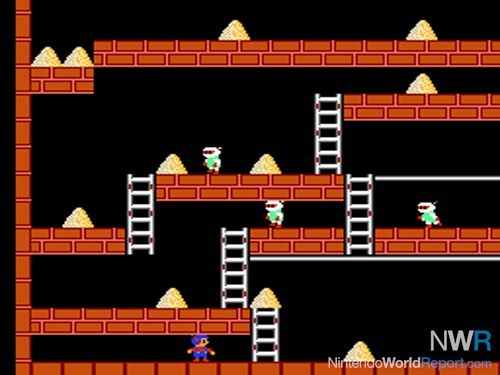
One day, while sitting at your computer, and reading Saddening Goat, you decided to go acquire lots of money very quickly. For most people, this may seem rather difficult, but not for you. You just do the same thing you do every night – go into a labyrinth, and collect treasure than happens to be scattered around, while avoiding the evil enemy monster/robot/thief things. If this is an accurate description of you, then you have probably discovered one of the best video games ever – Lode Runner.

Originally made for the NES in 1983, then remade many, many times, Lode Runner is a game where, as a random person wearing a blue hat and overalls, you walk around a puzzle board/maze, like that pictured above, collecting the random piles of money that conveniently happen to be lying around all over the place. Unfortunately, you have three enemies, which depending on the version of the game you are playing, could be monsters, robots, or other people that look like you but with a different color scheme. When they run into you, you put all your money back where you found it, and return to where you started, while the enemies do the same, then restart. This continues for a while until you get all of the gold in one go and leave up the ladder in the top right corner, which leads you to the next maze! And the cycle continues.


Fortunately, to fend off the evil people, you have a super power: at the click of a button, you can make a hole appear to the left or right of you! This is helpful in two ways. The first is that the evil people, for whatever reason, cannot look anywhere other than horizontally. Thus, if they're following you, and you make a hole appear in their path, they fall into it. This goes especially well with the second characteristic of the holes you can make – after a couple seconds, they magically close, and everything in them (generally evil people) dies. Unfortunately, when an enemy dies in Lode Runner, they just reappear at the top of the board a couple seconds later, but it wouldn't be interesting otherwise. Sometimes, though, the evil things manage to climb out of the holes before they close on them, so you don't always succeed in killing them if you manage to make them fall in a hole. You, however, can also fall in your own holes, and you cannot climb out, no matter what, because obviously, people with different color schemes than you have better upper-body strength.

If you happen to be on an upper level, however, the holes can help in another way: you can just jump through them, and land one level lower. This is especially helpful because when the enemies try to jump through holes that have no bottom, instead of falling to a lower level, they somehow float in the holes anyway, and just stay there until they lift themselves out or are crushed and "die." Also, if you make a series of holes in a row, and an enemy falls into one of them, when they climb out (which they do by holding onto… another hole… and lifting) they just fall right into the next hole!

Despite all these random impossible things that happen in Lode Runner, it is still one of the best games I have ever played. I highly suggest you go and download it from the Xbox Live Arcade, or the Wii Shop Channel, depending on what system you have, or going to someone's house who has a Wii or Xbox 360, and downloading it on theirs, and playing it there. It's worth it.

Looking back, I'm not sure if this whole post will make much sense to those who have never played Lode Runner. Therefore, you should all go here, and maybe watch other YouTube videos of Lode Runner as well, then come back, and it should make more sense. Hopefully. A la prochaine!

February 10, 2008

Sematic xiphoid

sematic (adj.): Serving as a warning or signal of danger. Used especially of the coloring of some poisonous animals.

xiphoid (n.): The posterior and smallest of the three divisions of the sternum, below the gladiolus and the manubrium.

Interestingly, xiphoid is also an adjective that means "shaped like a sword". I bring this up for no other reason than that swords are rather cool. In fact, so cool that I spent my entire american history research period on Friday looking at swords. This site has a bunch of purchasable cool swords, and maybe I'll randomly decide to purchase one one day. Of course, they sell other things besides for swords on that site - for example, if you feel at risk of being attacked, you could always purchase some chain mail (a word of advice, however: my very history knowledgeable friend says arrows can go through chainmail pretty easily). Or if you want, you can also buy full suits of armor, which will be good for decorating the Swedish castle I intend to own in the future.

But anyway, without further ado, here are the Top 10 Swords (in no particular order):

10.

It's Excalibur! Actually, it's not Excalibur... it's a letter opener... that happens to look like the sword in the stone. These must be pretty impressive/cheesy to have on your office desk; whenever a letter comes in you can draw the sword from the stone and mercilessly slice open your letter with triumph! (The stone is probably made out of metal, actually, but I wouldn't be surprised if it was stone... after all, they do have full replica suits of armor...)

9.

The Knights Swordbreaker Dagger

This isn't actually a sword either... it's just a dagger. But what this makes this dagger so cool (and also, remarkably distinct from the slightly commonplace assassin-type daggers) are the grooves along its 16 inch blade. And no, the grooves aren't just for grating cheese. The grooves are also awesome at catching and often breaking an incoming sword blade. It was also used often in two-handed fencing/dueling in medieval Italy, but that's another story (involving throwing your cloaks over other people's heads, shaking hands, and why you hold daggers in your left hand).

8.

Union Officers Civil War Sword

A sword used during the Civil War by Union officers (you see, the research was sort of relevant...) A 29 inch blade, 35 inches altogether including the hilt. Of course, by this time, swords were becoming a bit useless, but generals still liked them, and they meshed well with the old-style concept of military honor. In fact, here is an entire page about proper etiquette of sword usage (taken from the military manual of the time).

7.

Scottish William Wallace early claymore sword.

It's William Wallace's sword! He's like, the guy from the intro campaign in Age of Empires 2. What more has to be said?

(It's a replica of his claymore, btw. 56.25 inches.)

6.

Hurray for gigantic German swords. This one happens to be 6.25 feet tall, so it's probably larger than you are. This type of sword is called a "Landsknecht" sword - I mistook it for a "zweihander", the huge German sword that's probably more familiar to people (there should be two dots on top of the i, but I'm not going to look up German accented characters right now). In any case, I found it pretty amusing that over half of the sword consisted of the hilt. Of course, huge 5 foot long blades would be near impossible to forge, but whatever.

I always wondered what two people dueling with zweihander's would look like, but much to my dismay, Wikipedia has informed me that really the ways you'd use a huge sword like this would be to a. run into a bunch of pikemen and swing it wildly, in the hope that you'll break their formation and not be skewered, or b. run around swinging it wildly in the hopes of tripping enemy cavalry. Personally, I think the most effective way to use it would just be to spin it in a circle. Repeatedly.

5.

The Knights Templar Sword Direct from Toledo Spain

It's the Knight's Templar Sword! Impressively cool to people that have played Assassin's Creed (unfortunately, they don't sell ring finger blade replacements).

The total length is 46.5 inches. Cool hilt design (the writing on the bottom of the hilt seems to say "Cristi De Templo", which is probably Latin for Knights Templar (but perhaps not?)

4.

The Sword of Merlin made in Toledo Spain

It's Merlin's Sword! 45 inches long... the hilt is cool, but I wonder what bird is on the pommel (probably if I knew some more Arthurian stuff I'd get it).

3.

Demon Slayer Sword direct from Toledo Spain

This time it's the Demon Slayer's sword! Another sword from Toledo, Spain (in fact, most of the Toledo Swords, which include the above three, are pretty awesome), you can use it to slay demons! This is because there's a demon's face on the pommel, of course.

2.

Sword of Power direct from Toledo, Spain

The website calls it the Magnificent Sword of Power, and although I don't really see why, it must be pretty magnificent then. And powerful. Also 45 inches long.

1.

Odachi Samurai Sword

The Odachi Samurai sword! No collection of random swords is complete without throwing in any Japanese swords (which, may I remind you, are far better than their European counterparts). I'm not sure if this replica can, but the samurai swords of Ancient Japan could slice through a tree in one swing. In fact, their blacksmithing was so awesome that anyone who revealed the secrets of samurai sword forging would be killed (this is just like the silk thing by the way).

This is a 67 inch sword, which makes it pretty big, even for a samurai sword. Actually, that reminds me, we do have a samurai sword somewhere in my house - it's not as impressive as this though.

---------------------------------------------------------------------------------

That concludes the top 10 swords thing. By the way, if you ever want to learn about (or just hear the names) of exotic ancient weaponry, go play Diablo or Diablo II - since you get new weapons every 2 or 3 levels, you end up hearing a lot of exotic weapon names. Of course, World of Warcraft has a bunch of interestingly named weapons too - which reminds me, they're making a documentary about WoW addiction =P. Enjoy.

That's all for now. I think I'll start focusing my posts more on individual topics - and also start titling them relevantly (but don't worry, I'll keep the random phrase, just probably move it to the postscript). But it really depends whether I feel like it or not. Until then, ciao.

-squidout

Yawn

We somehow managed to go two whole days without any posts. I, therefore, have made another logic puzzle. I think Jon will be able to solve this one with an algorithm, as I probably could, but whatever. Good luck!

Six intrepid explorers traveled to various parts of the world hoping to find new places and places that time had forgotten, unfortunately they all came to a rather fateful end, but not necessarily where and how you would expect.

Each spent 1, 3, 4, 6, 7, or 12 months traveling, and no two spent the same amount of time.

What was each explorer's name, how many months had each explorer been traveling what place did they travel too and what was the cause of death (one of them died of starvation, obviously)?

Fearless Dan went to Swampy Creek for 2 months longer than the explorer who died of a viral illness. Whoever died from a high fall (after climbing a tree to rescue a sloth, was this in the Rain Forest) traveled for less time than the person who died from Food Poisoning.

Valiant Jack traveled for 2 months less than the explorer eaten by a crocodile. Adventuresome Sam traveled for 1 month less than the explorer who went to the Frozen Wasteland. The explorer who went 'Sailing the Oceans' was away for the longest before succumbing to his fate. The explorer who died after 3 months didn't travel to the Long Lost City.

Barry Brave did not die of Food Poisoning. Courageous Fred traveled for 3 months more than Daring Derek. The explorer who visited the Dirty Desert traveled for 6 months more than the person who died of Hypothermia after they tripped over a seal and plunged head first through thin ice.

February 7, 2008

Bradytelic nylghau

bradytelic (adj.): of or pertaining to evolution at a rate slower than the standard for a given group of plants or animals.

nylghau (n.): large Indian antelope; male is blue-grey with white markings; female is brownish with no horns

Hmm, I didn't know there were antelope (this is the correct plural, I presume) in India. Antelope are supposed to run around in the savannas of Africa, and then subsequently be eaten by large predatory mammals. But it makes sense that you'd get some in southern regions of eurasia too.

Also, hurray for Mexican traffic laws! If only people were sane to a sufficient degree...
In other news, I got a Khet game. The lasers are pretty cool - I should probably find somebody to play it with though. It's basically the same as laser chess.

Anyway, onto the main point of this post: our (Canada+US) highschools suck.

Although true, that's not a very insightful main point, so I'll follow it up with main point #2: that's a good thing.

Now, some people will probably say that our highschools aren't that bad. But they are. I think I was pretty much always aware of this, but recently it was brought to my immediate attention by my friend from Japan, who showed me the University of Tokyo Math Entrance Examination (Science Stream). Now, the high school I go to is supposed to be pretty good, but I'm aware that there are only about two people (maybe 3) in the entire school who can actually solve any of the questions there. That bodes pretty sadly.

Now, the ducated person might notice that the University of Tokyo is like Japan's elite school - so the science stream exam is undoubtedly going to be hard, especially considering the population applying. But so few people able to solve one question is pretty pathetic. Forget comparing this to like, the SAT, or even AP Calculus. This year's COMC is practically a joke in comparison to that.

Of course, it might be fairer to look at what tests regular people in Japan have to write. And they are here. The first part is basically their 'SAT'. It's quite doable, but the American SAT is really a joke in comparison. Then, if you scroll down, you'll find the entrance examinations for the good universities. The best students in our school would probably have tons of trouble just doing the humanities section.

Now, for some people the above facts might suggest that our education (and particularly, our public education) needs to improve a lot. But really, while it would be good if it improved a bit, it's not that necessary. The reason for this?

Well, if a school improves, that's practically equivalent to: the students will have a harder time at it. And from what I hear about Japan (especially with the cram schools, etc.) all the students basically do is work.

Now, with sucky schools, there's the obvious disadvantage that there are a lot of people that don't learn anything, and are thus relayed to rather menial jobs. Moreover, the general population becomes pretty uneducated, and in a democratic society, that's less than ideal.

But there's also lots of free time - and this gives people, especially those who can breeze through the low level public education, a lot of free time to do whatever they like. And it's that type of environment that fosters creativity, which ultimately leads to the US's wealth.

Of course, it's probably more circular than that - the US's wealth attracts the best people from everywhere else, so after a while, the US high schools don't matter anymore - just the universities, which are good. But everything above is just speculation, after all. Education is a pretty random thing.

-squid out

There once was a buggy AI
Who decided her subject should die.
When the plot was uncovered,
The subjected discovered
That sadly the cake was a lie.


(courtesy of munroe's limerick site)


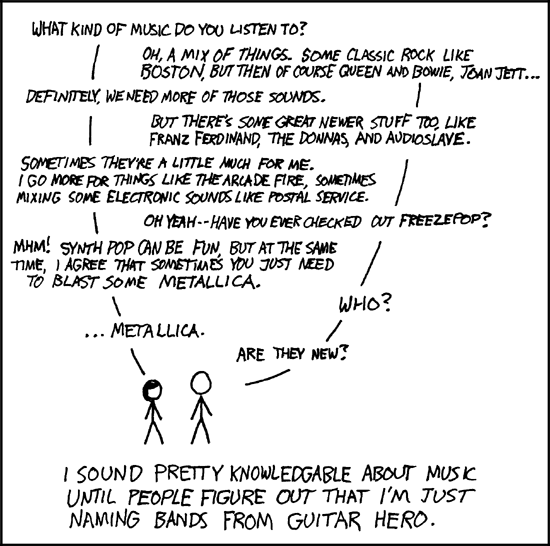
Also, the xkcd today is really cool (but think hard enough about it first):


Happy Chinese New Year!

It's the year of the rat, the beginning of another twelve-year cycle.
space
May lots of money, food, and good fortunes come your way :)

February 6, 2008

Scythian Suite

I know that these entries are supposed to be much more than just rants about nothing (or should it), but thought you guys might be interested in hearing a piece of music I came across a couple weeks ago, while I was on my dreaded Saddening Goat sabbatical.

The piece is Scythian Suite by Sergei Prokofiev. One of his more primal works, it was actually nearly set to a ballet, which would have been amazing. Its a great piece, although the link I'm posting is only a 4 minute segment of it. But the 4 minutes are sure great. The performers are the Rotterdam Orchestra, noted for their colourful interpretation of post romantic music, and the charismatic Valery Gergiev. Some say his conducting style is on the verge of violent, and he has been known to scream mid-piece and grunt. It may be scary from a performer's point of view, but the results are magnificent, especially when he works with his main orchestra, Kirov Orchestra in Russia. I can't wait to see what he will do with the London Symphony Orchestra, now that he has been appointed Artistic Director and Principal Conductor. For those not too familiar with orchestras, the LSO is the orchestra that brought you the music to Star Wars (all 6 movies) and Harry Potter.

Enjoy and post your reactions to this AMAZING piece:

Scythian Suite-Valery Gergiev, Rotterdam Orchestra
http://youtube.com/watch?v=-hQglagzHqI

Also, for some humor, some guy made fun of Gergiev on YouTube..its quite hillarious
http://www.youtube.com/watch?v=rCGQdjdGv2A&NR=1

Clupeid Rauwolfia

Clupeid - Of, relating to, or belonging to the family Clupeidae (various widely distributed soft-finned fishes, which includes the herrings, menhadens, and sardines).

Rauwolfia - a genus of evergreen trees and shrubs in the Apocynaceae family. The approximately 85 species in the genus can mainly be found in tropical regions.

The last few days, I learned that with enough people, you can make Wikipedia say anything. To an extent.

Note: some words in the following paragraph had their letters reversed so that this post does not come up when searching for certain phrases on Google. You will understand why soon enough.

In French class the other day, two of my friends made a page about a Dr. hsoJ namlA, professor of botany at UofT. The two of them and I have been adding onto it little by little, and trying to fight off the various claims to delete the page. I have a theory that if only one person had made the page and done all the editing, they would have deleted the page near instantly, but as three different users have been working on it, they had to delay for a while. They did put up a candidate for deletion template on the page, however, and so far all moderators who have viewed the page have voted to delete it, which shows that you can't really put just anything onto Wikipedia. Basically, from what I've learned from this page, you shouldn't trust an article on Wikipedia if it has been edited within the last minute or has a deletion template on it, and if neither of those is the case, it's probably fine. For fun, though, you can go to the page, and add whatever you want to it. Just try to make it realistic-ish, so that maybe we can keep the page for another couple days. Hopefully the people researching whether Dr. namlA exists won't come here and find out the truth (that's why words were reversed, by the way).

Also, you should click on the links to the moderator discussions about the page. Some of them are quite funny. Plus, because anyone can edit any page Wikipedia, you can change what their discussion says! They change it back almost instantly when you do that, though, so watch out. While Wikipedia is a great idea, and useful resource, I guess there is a backside to everything.

Now, onto Guitar Hero! Basically, Jon seems to dislike it because it has rock music in it, and FFR has a higher BPM (beats per minute, in case you didn't catch on in his post) than Guitar Hero does. As for his problem with rock music, I cannot help it if he has bad taste in music. Most of the songs he seems to like are techno/trance, which I like to an extent as well, but obviously there are some differences between techno and rock. Basically, all I can say is that whether or not you like the music is preferential, and just because Jon doesn't, that doesn't mean Guitar Hero is a bad game. Plus, there are some songs like this and this (beware: there is a long intro) which I think that even he would like.

Regarding the BPM, I completely agree that some songs in FFR have much higher BPMs than most in Guitar Hero do. I don't think that this is a problem. When the goal is to hit arrow keys that are right next to each other, you can generally hit more notes than when you are using a guitar hero guitar to play. However, not only do I find the guitar controller much more fun to play with, but I think playing with arrow keys is pretty lame. It's pretty much the equivalent of playing dance dance revolution with an Xbox controller instead of a dance mat. Those of you who play DDR should know that that takes away all the fun. Plus, some Guitar Hero songs can have very high BPMs, but they are generally difficult for other reasons, like rhythm or playing lots of chords.

In other news, CBC is very evil. They decided to move jPod from Tuesday nights at 9:00 to Friday nights at 9:00. I went to my television yesterday expecting to watch another episode of jPod, and instead found myself watching some random sitcom about hockey players' wives… Also, I generally have things to do on Friday nights. Humph. Fortunately, you can watch all episodes of jPod online at their site, so it's not too bad. I'll just have to watch jPod on Saturdays instead of Tuesdays.

Speaking of watching television on the internet, everyone should check this out – the Comedy Network put recent episodes of the Colbert Report and the Daily Show and South Park, among other more memorable episodes of each, online to watch whenever you want, without ads. Well, that's not entirely true. There are ads for some show they started online called Lil' Bush, which, surprisingly, has not been taken down by the FBI. Just watch a few ads for it, and you will see what I mean.

Speaking of which, Super Tuesday went by yesterday pretty much as expected for the Democrats – neither Obama nor Clinton have a non-trivial lead, and according to pretty much everyone, the battle is going to get nasty. Unfortunately, when it comes to politics, nasty isn't usually what you would expect. Stephen Colbert actually talked about this in his episode two Tuesdays ago, so you should go watch it! I won't say any more, so that I don't spoil it for you. Plus, he makes everything seem funnier than it really is. I got his book, I am America (and so can you!), and it's really funny, even though I disagree with a fair portion of it. I would suggest reading it, when you are taking a break from playing Guitar Hero, or urgently awaiting Brawl (I assume you spend your time doing the same things that I spend my time doing).

As for Republicans, McCain has pretty much won. I hope he doesn't win the real election, though (this one was fake, of course). He seems to be very similar to the current president. According to an article I read in the Globe and Mail the other day, Republicans are very lucky that Canadians can't vote in the American elections, because over 90% could vote Democratic, almost regardless of which candidate was representing them, mostly because they don't like Bush. Therefore, my opinion is probably fairly prominent among people here in Toronto.

Anyway, after spending a fair amount of time writing this instead of playing Guitar Hero, I think I need to return, or something like what happens to Ethan from CAD when he doesn't play video games for a decent amount of time might happen to me as well. Well, maybe a lower-scale version of that. Anyway, until next time!

February 3, 2008

Too Much Music

Yelling About Music is the music blog of Jeph Jacques, the creator of Questionable Content, where he...well...yells about music. Indie rock, mostly.

I just read his post from Friday, in which he talks about how there is too much music sometimes; I completely agree. Jeph talks about 1) how he doesn't have enough time to listen to the cds he buys and to keep up with the new stuff coming out ; 2) how ubiquitous MP3s are nowadays, and how that affects people's relationship with music, 3) how his experience at a music festival was unpleasant because there was constantly music, from which he could not escape; and coming up witht he conclusion about how even though he loves music, he wishes there were less of it.

I got an iPod for Christmas 07, and spent the good part of the second week of the break uploading music from cds, and getting album art, and loading them into my iPod. Currently I have exactly 800 songs on my iPod, and when I first got it I thought I would hover around 500 songs. But new stuff keep coming out, and I started a Textpad list of bands/artists that I should check out or get songs from - from friends, papers, blogs, online acquaintances, etc. - and for every one that I listen to there's another two that I add. There are about 60 items on that list right now; it's frustrating.

This trying to clear the list negatively impacts my listening experience. When I hear a new cd, sometimes I don't have the patience to hear all of it the first time, and I dismiss it. If I get the chance to hear it a second time, and give it a thought, I might turn out to love it (many past examples - Arctic Monkeys, Buckcherry, and Tokyo Police Club* being examples that I didn't like at all first time I heard them, but I love now). Now I know I do this, and make myself listen to stuff at least twice before making up my mind about it.

I used to observe people on buses and the TTC; now I put on the earphones. Sometimes I do get tired of music, and stop myself from doing that. I think I shall observe No Music Day this year, if just to see if I can do it, on my own free will. It's nice to have a little quiet once in a while


Cindy

* I realize not all SG authors and readers will agree with my taste in music, but I do have a right to write about my preferences, so...debate me if you wish :P

P.S. Kinda related, kinda unrelated, but still funny: